
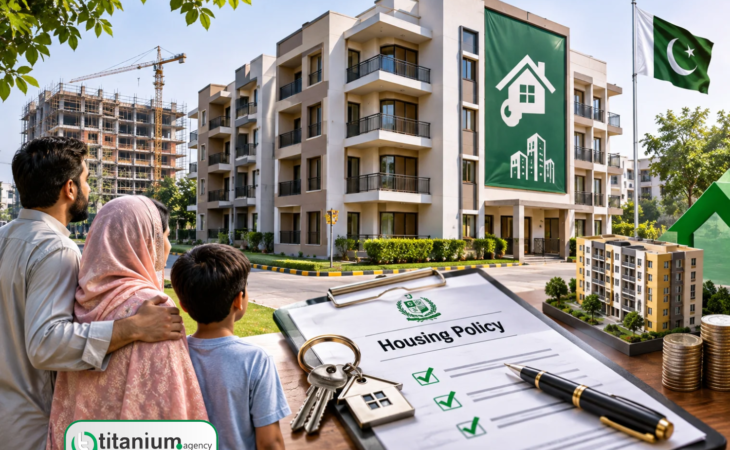
Pakistan’s real estate sector is entering an important phase as the government introduces new housing policies, affordable housing finance schemes, and initiatives to support residential development. For millions of Pakistanis, owning a house or apartment remains a major financial challenge because of rising construction costs, expensive land, higher property prices, and limited access to housing finance.
The demand for affordable apartments in Pakistan is increasing, especially in major cities such as Lahore, Islamabad, Karachi, Faisalabad, and Rawalpindi. Many middle-income and low-income families are now looking for smaller apartments, installment-based properties, and government-supported housing finance options instead of expensive independent houses.
To address these challenges, the government has introduced initiatives such as the Wazir-e-Azam Apna Ghar Program (Ghar Ho Tu Apna) and revised the Mera Ghar Mera Aashiana affordable housing finance scheme. The National Housing Policy has also placed greater focus on affordable housing, vertical development, improved housing finance, and sustainable urban planning.
But the important question is: Will Pakistan’s new housing policies actually make affordable apartments more accessible to ordinary buyers?
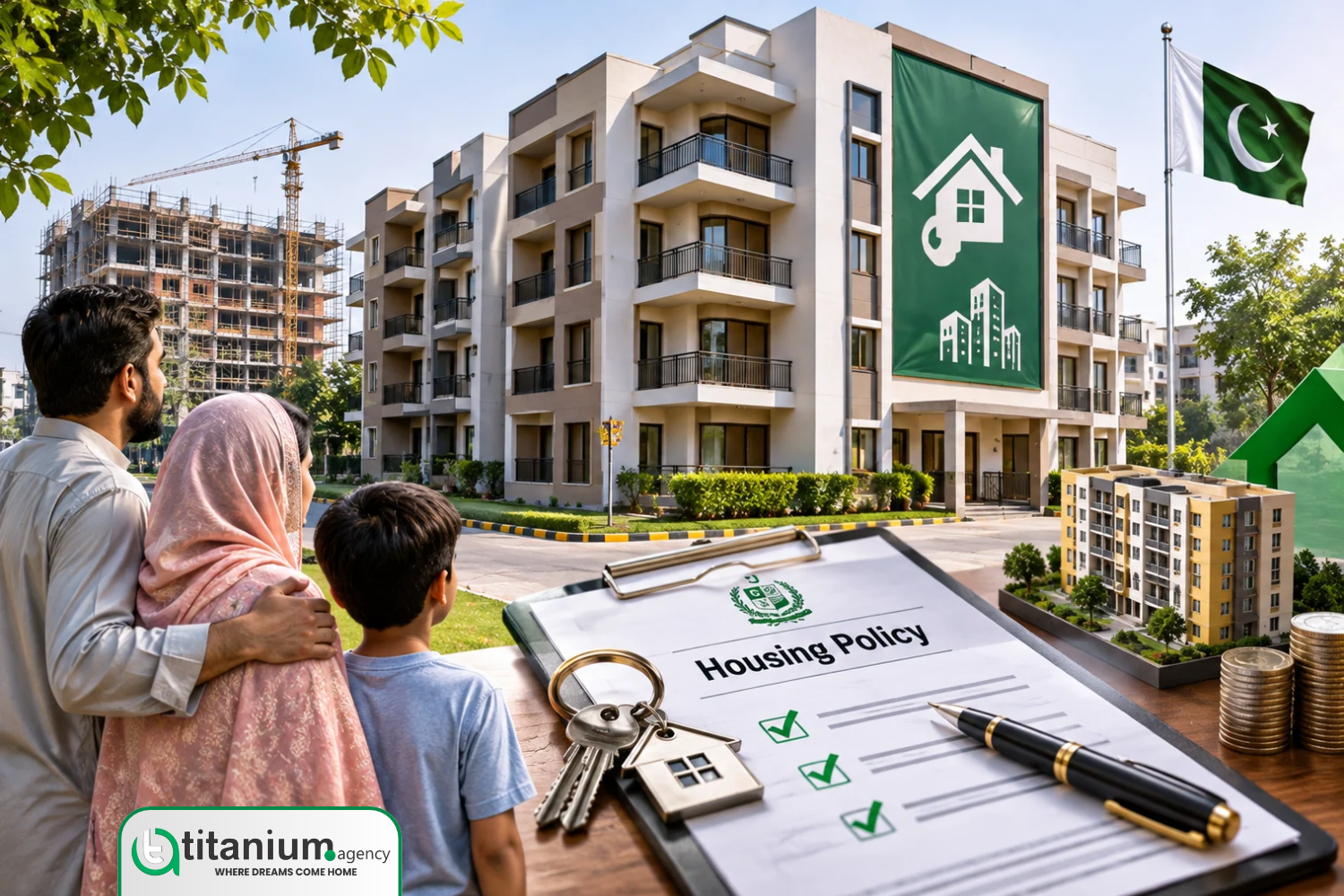
In this detailed report, Titanium Agency Pvt. Ltd. explores Pakistan’s latest housing policies, government financing initiatives, affordable apartment opportunities, real estate investment trends, and the future of the residential property market.
Housing affordability has become a major concern in Pakistan. Rapid urbanisation, population growth, rising construction costs, and limited housing finance have increased the pressure on the residential property market.
The federal government has introduced policy measures to improve access to housing and encourage private developers to participate in affordable residential projects.
The National Housing Policy 2026 was approved by the Federal Cabinet in August 2026, providing a national framework for housing and urban development after the previous national policy was introduced in 2001. Its key areas include land availability, housing finance, construction technology, affordable housing, low-income housing, rural housing, and sustainable urban development.
The policy aims to improve housing opportunities for different income groups and support better planning across Pakistan.
The important objectives include:
These policy objectives could create new opportunities for the affordable housing sector if supported by effective implementation and long-term financing.
One of the important government initiatives is the Wazir-e-Azam Apna Ghar Program, introduced to support people who want to purchase or construct their own homes.
The programme was launched on April 30, 2026, with a five-year target of financing 500,000 housing units through a planned financing programme of approximately PKR 3.2 trillion. Ministry of Information and Broadcasting+1
The scheme aims to make homeownership more accessible through subsidised housing finance.
According to the official programme information, its main features include:
The government programme covers eligible houses up to 10 Marla or 2,720 square feet and apartments up to 1,500 square feet. PHA+1
The scheme is designed for first-time homeowners.
The published eligibility information identifies the following requirements:
Final approval depends on the applicable programme rules, bank assessment, documentation, and repayment capacity.
The programme may provide an opportunity for eligible families who cannot afford to pay the full apartment price upfront.
For example, a buyer purchasing an eligible apartment may be able to finance part of its price through the scheme, subject to the maximum loan limit and bank approval.
This can make apartment ownership more accessible to salaried individuals, young families, and first-time property buyers.
However, a subsidised markup rate does not mean that every apartment automatically qualifies. Buyers must confirm property eligibility and financing terms with participating financial institutions.
Another important development is the revision of the Mera Ghar Mera Aashiana housing finance scheme.
On February 27, 2026, the Economic Coordination Committee approved revised features to improve access to low-cost housing finance. The changes include an increase in the maximum loan amount to PKR 10 million, a uniform 5% customer markup rate, and expanded eligible housing sizes. Government of Pakistan |+1
| Feature | Revised details |
|---|---|
| Maximum financing | PKR 10 million |
| Customer markup | Fixed 5% |
| Apartment size | Up to 1,500 sq. ft. |
| House size | Up to 10 Marla / 2,720 sq. ft. |
| Financing period | Up to 20 years |
| Buyer’s contribution | Generally 10% |
| Processing charges | No processing cost under the scheme |
| Early repayment | No prepayment penalty |
The revised scheme is intended to improve housing finance access for eligible applicants and support the purchase or construction of residential properties.
Housing finance can become expensive when interest or markup payments increase the overall cost of a property.
A fixed customer markup of 5% under the government-supported scheme can reduce the financing burden compared with higher-cost borrowing options.
For families with regular incomes, this may make long-term apartment financing easier to plan.
However, buyers should understand that the 5% rate applies under the scheme’s conditions and is not a general rate offered on every property loan.
Pakistan’s updated national housing policy is another important step towards addressing the country’s housing shortage.
The policy framework places emphasis on increasing residential supply, improving land utilisation, and encouraging vertical housing development.
The government is looking at apartment buildings and high-rise residential projects as one way to use urban land more efficiently.
Major cities are expanding rapidly. Traditional low-rise housing requires more land, while vertical developments can accommodate more families within a smaller area.
Affordable apartment projects may help address several urban housing challenges.
Some potential benefits include:
Better Land Utilisation: High-rise buildings can provide more residential units on limited urban land.
More Housing Supply: Apartment developments can increase the number of available homes in established cities.
Access to Urban Facilities: Properly planned apartment projects can provide access to roads, schools, hospitals, and commercial areas.
Lower Entry-Level Property Costs: Smaller apartments may have lower total purchase prices than independent houses, although affordability depends on location and construction costs.
Reduced Urban Expansion: Well-planned vertical housing can help limit unnecessary expansion into agricultural and undeveloped land.
The National Housing Policy 2026 identifies vertical development, housing finance, land management, and sustainable construction among its strategic areas. Pakistan Identification Database+1
The answer is potentially yes, but the actual results will depend on how effectively these policies are implemented.
Government-backed financing can help eligible buyers purchase apartments. At the same time, increased construction activity and private-sector participation could improve the supply of residential units.
Several factors will determine whether affordable apartments become easier to purchase.
Affordable financing is one of the biggest requirements for first-time property buyers.
A loan facility with a subsidised markup rate can help eligible families manage their payments over a longer period.
This may increase demand for smaller residential apartments in major cities.
The government is encouraging more vertical residential development.
If private developers introduce properly planned and reasonably priced apartment projects, buyers may have more choices.
This could benefit people who cannot afford large residential houses.
Pakistan’s housing finance market has historically remained limited compared with the overall size of the economy.
Improved mortgage facilities, simpler banking procedures, and better risk-sharing arrangements could help more people access residential financing.
Private real estate developers play an important role in increasing housing supply.
Government support for affordable housing finance and developer financing may encourage more companies to invest in apartment construction.
Housing demand is not limited to Lahore, Karachi, and Islamabad.
Cities such as Faisalabad, Multan, Gujranwala, Sialkot, Peshawar, and Hyderabad also need affordable residential options.
Supporting housing development in smaller cities could create more opportunities for families and investors.
Lahore is one of Pakistan’s major real estate markets. Its growing population, educational institutions, commercial centres, and employment opportunities continue to create demand for residential property.
However, the cost of buying a house in many developed areas can be beyond the budget of middle-income families.
This is why smaller apartments and installment-based residential projects are becoming important options for property buyers.
Lahore offers several areas where residential apartment developments can serve different income groups.
Some important locations and development corridors include:
The suitability of each location depends on property prices, road access, available facilities, legal approvals, and development quality.
Not every family needs a large house. Many people prefer a smaller apartment that offers basic residential facilities and manageable maintenance costs.
The following apartment categories may attract different buyer groups:
| Apartment category | Potential buyers |
|---|---|
| Studio apartments | Students and individuals |
| 1-bedroom apartments | Couples and small households |
| 2-bedroom apartments | Small families |
| 3-bedroom apartments | Larger families |
| Affordable rental apartments | Salaried professionals |
The demand for smaller apartments could grow if prices remain within the financial reach of middle-income households.
Government housing initiatives may influence the residential property market in several ways.
Investors should understand that affordable housing policies are designed mainly to improve homeownership and housing supply. They are not a guarantee of higher property prices or investment returns.
Residential Apartment Projects
Affordable apartment developments may attract buyers who want a residential unit at a lower total purchase price than an independent house.
Rental Property Investment
Smaller apartments in areas with educational institutions, hospitals, offices, and commercial markets may attract tenants.
Construction and Development Sector
Increased housing activity can create opportunities for construction companies, building material suppliers, architects, and property developers.
Commercial Property Near Residential Projects
New residential developments can create demand for grocery stores, pharmacies, restaurants, and other neighbourhood businesses.
Long-Term Property Investment
Investors may evaluate areas where infrastructure improvements and new residential developments could support future housing demand.
Before purchasing property, investors should consider:
Affordable housing policies may create new opportunities, but careful property selection remains essential.
Despite new government initiatives, several challenges may affect the success of affordable housing programmes.
Cement, steel, labour, transportation, and other construction expenses can increase the final price of residential apartments.
Developers may find it difficult to offer affordable units if construction costs continue to rise.
Many potential buyers work in the informal sector or do not have regular documented incomes.
Such applicants may face difficulties meeting bank financing requirements.
Suitable land in major cities is expensive. Finding land that allows developers to construct affordable apartments while maintaining reasonable project costs is a major challenge.
Long approval processes can delay construction and increase development expenses.
Clear regulations and efficient approval procedures can support faster housing development.
Government financing can increase buyers’ purchasing capacity, but the market also needs enough suitable apartments.
If housing supply does not increase, higher demand could put additional pressure on property prices.
A housing policy can only deliver results when government departments, financial institutions, developers, and regulatory authorities work together.
Regular monitoring is necessary to ensure that affordable housing benefits reach the intended buyers.
First-time property buyers may be among the main beneficiaries of government-supported housing finance.
However, buyers should prepare before applying for a housing loan.
Here are some useful steps:
A buyer should never select an apartment only because it qualifies for financing. Location, construction quality, legal status, and total cost are equally important.
Private developers can play an important role in making residential property more accessible.
The housing shortage cannot be addressed through government financing alone. More residential units must also be constructed at prices that ordinary families can afford.
Developers can contribute through:
A balance between affordability, construction quality, and project profitability is important for long-term success.
The future of affordable housing in Pakistan will depend on the government’s ability to turn policy objectives into practical results.
The introduction of subsidised housing finance, support for private developers, and greater attention to vertical residential development are important developments.
If these initiatives are implemented effectively, they could improve access to residential apartments and encourage more families to become homeowners.
Lahore, Karachi, Islamabad, and other growing cities may see increased interest in smaller apartments and organised residential developments.
The construction industry could also benefit from greater demand for residential units, creating opportunities for businesses and employment.
However, long-term success will require affordable land, reliable financing, efficient approvals, quality construction, and transparent property transactions.
The government’s housing initiatives include significant financing targets and support for eligible homebuyers.
The following figures help explain the scale of the programme.
| Programme detail | Announced information |
|---|---|
| Housing finance target | 500,000 units |
| Planned programme financing | Approximately PKR 3.2 trillion |
| Maximum individual loan | PKR 10 million |
| Customer markup | 5% |
| Maximum financing period | 20 years |
| Eligible apartment size | Up to 1,500 sq. ft. |
| Buyer’s equity contribution | 10% |
The National Assembly reported that by April 30, 2026, the scheme had received 25,304 applications, with 8,990 applications involving PKR 37.154 billion approved and PKR 5.071 billion disbursed to 1,845 beneficiaries. These figures show that financing activity has started, but also that significant work remains to reach the overall target. na.gov.pk
Pakistan’s updated housing policy framework focuses on affordable housing, improved housing finance, vertical apartment development, better land utilisation, and sustainable residential construction.
It is a government-supported affordable housing finance initiative designed to help eligible first-time homeowners purchase or construct residential properties through subsidised financing.
The announced maximum financing limit is PKR 10 million, subject to eligibility and bank approval.
The published scheme provides a fixed customer markup rate of 5%, subject to applicable programme conditions.
Yes. Eligible applicants can seek financing for apartments of up to 1,500 square feet, subject to the scheme’s requirements and participating bank approval.
The programme is designed for Pakistani citizens who are first-time homeowners, hold valid CNICs, and meet the applicable financial and property requirements.
Government-supported financing may improve purchasing power, while increased apartment construction could expand housing supply. However, actual apartment prices will depend on land costs, construction expenses, location, and market demand.
The policies may encourage apartment development, improve access to housing finance, and increase interest in smaller residential units across Lahore.
They may offer opportunities for personal residence and potential rental income. Investors should evaluate location, legal approvals, construction quality, rental demand, and total purchase costs before investing.
Private developers may benefit from improved housing finance arrangements, increased demand, and initiatives supporting residential construction. Actual benefits will depend on programme implementation and developer eligibility.
Pakistan’s new housing initiatives represent an important development for the country’s residential property sector.
The Wazir-e-Azam Apna Ghar Program, revised affordable housing finance scheme, and updated National Housing Policy provide a framework to improve housing access for eligible families.
The focus on 5% subsidised customer markup, financing of up to PKR 10 million, and apartment financing for eligible units could help first-time buyers explore homeownership with more manageable financing arrangements.
At the same time, Pakistan needs more affordable residential apartments, transparent development projects, reasonable construction costs, and better urban planning.
For Lahore and other major cities, vertical housing and smaller apartment developments could become an important part of the future real estate market.
At Titanium Agency Pvt. Ltd., we believe that affordable housing can create new opportunities for families, property buyers, developers, and investors.
The real success of these policies will depend on implementation, transparency, and the availability of quality residential properties at prices ordinary Pakistanis can afford.
Affordable housing is not just about building more apartments. It is about making homeownership possible for more people.
Disclaimer: This article is prepared for general property market information by Titanium Agency Pvt. Ltd. Government housing programmes, financing limits, markup rates, eligibility requirements, and policy implementation may change. Loan approval is subject to the applicable government scheme rules and participating financial institution assessment. Readers should verify current conditions through official government and banking channels before making financial decisions.
Start a Conversation →
Have questions about properties or investment opportunities? Our team is here to guide you. Get in touch with Titanium Agency today for expert advice and the latest property options.
Looking for property investment in Lahore, luxury apartments, commercial property, apartments on installments, or the latest real estate projects in Pakistan?
Contact the Titanium Team for current prices, availability, payment plans, project details, and booking assistance.
📞 Call / WhatsApp: +92 310 0001036
📞 Call / WhatsApp: +92 334 4139539
📧 Email: query@titaniumagency.net.pk
🌐 Website: titaniumagency.net.pk
📍 Lahore Office: 163 & 164-A Commercial, Sector C, Bahria Town, Lahore
Titanium Agency & Consultancy – Your Real Estate & Property Investment Partner.
Project prices, availability, payment plans, development status, and other details may change. Please verify the latest information and official documentation before making any investment or booking decision.
Contact Us

If you wish to buy or sell a property whether it be residential or commercial, then you have come to right place. Titanium Consultancy is a group of seasoned professionals having vast experience in this field, we guide our customers in making right investment decisions keeping in view their budget.
Leave Your Comment